Specs :: Classes
Each character, be it hero or foe, is derived from a specific character class which defines the base resistances and other properties.When a character is instantiated, he inherits (a copy of) the default settings of his class.
| Name | Default value | |
| RESISTANCES | ||
| 0 | DeathBlow | 67 % |
| 1 | Stun | (varying) |
| 2 | Blight | (varying) |
| 3 | Bleed | (varying) |
| 4 | Disease | (varying) |
| 5 | Debuff | (varying) |
| 6 | Move | (varying) |
| 7 | Stress | (varying) |
| 8 | Darkness | (varying) |
| PROPERTIES | ||
| 9 | Food efficiency | 100 % |
| 10 | Appetite | 100 % |
| 11 | Scout chance | (varying) |
On top of that, a character's array is extended by individual Modifiers:
| Name | Default value | |
| MODIFIERS | ||
| 12 | MaxHP | 0 % |
| 13 | ACC (melee) | 0 % |
| 14 | ACC (ranged) | 0 % |
| 15 | DMG (melee) | 0 % |
| 16 | DMG (ranged) | 0 % |
| 17 | CRT (melee) | 0 % |
| 18 | CRT (ranged) | 0 % |
| 19 | Dodge | 0 % |
| 20 | Speed | 0 % |
| 21 | Prot | 0 % |
| 22 | Heal | 0 % |
| 23 | Heal Recieved | 0 % |
| 24 | Move skill chance | 0 % |
| 25 | Stun skill chance | 0 % |
| 26 | Blight skill chance | 0 % |
| 27 | Blight skill DMG | 0 % |
| 28 | Bleed skill chance | 0 % |
| 29 | Bleed skill DMG | 0 % |
The values of the entire array can be altered by buffs/debuffs and trinkets.
Specs :: Hunger
The hunger value [0 ... 100 %] represents energy/calorie requirement (ERQ).At mission start, a hero is always full (ERQ at 0 %).
During a dungeon run, hunger gets incremented by each segment (room or hallway part) visited.
Below 75 %, hunger value is no concern.
When ERQ reaches 75 %, the hero signals a 'hungry' message.
When ERQ reaches 90 %, the hero signals a 'very hungry' message.
When ERQ reaches 100 %, the hero is about to starve and enters a Death Door State.
Walking hungry (ERQ > 75 %), each crossing of a segment lets the hero suffer an increasing dose of stress which can accumulate quickly.
Hunger can only be decreased by giving the hero something edible; typically a Food ration (meal), which on average equals 37.5 % ERQ. Alternatively he can be fed Medicinal Herbs (worth 0.5 Food = 18.75 % ERQ), Happy-P or Hycatox (both worth 0.25 Food = 9.375 % ERQ).
Growth rate
Per visited segment, ERQ raises by about 3.125 %. In other words, if a hero eats nothing, then...... the first 'hungry' message likely appears on the 24th segment (~ 5 rooms) after the starting room,
... the 'very hungry' message follows on the 29th segment (~ 6 rooms),
... and starvation risk finally occurs on the 32th segment.
| ROOM | |||||||||||||||||||||||||||||||||||
| 0 | 1 | 2 | 3 | 4 | 5 | 6 | 7 | ||||||||||||||||||||||||||||
| H | V | ! | |||||||||||||||||||||||||||||||||
| 0 | 1 | 2 | 3 | 4 | 5 | 6 | 7 | 8 | 9 | 10 | 11 | 12 | 13 | 14 | 15 | 16 | 17 | 18 | 19 | 20 | 21 | 22 | 23 | 24 | 25 | 26 | 27 | 28 | 29 | 30 | 31 | 32 | 33 | 34 | 35 |
| SEGMENT | |||||||||||||||||||||||||||||||||||
Typically, the best time to feed a character is when his hunger value has risen above ~40 % (so the entire Food unit can be exploited) and is still under 75 % (to avoid the unnecessary stress related first hunger event).
Food requirement
The following table shows the absolute minimum of Food needed to avoid hunger events for non-modified characters.| Mission size | Energy required (ERQ %) | Food units equivalent | |||||
| total | safe minimum | ||||||
| Length | Rooms | Segm. | per Hero | Party | per Hero | Party | |
| tiny | 2 | 5 | 15.625 | ~ 0.4 | ~ 1.7 | (0) | |
| 3 | 10 | 31.25 | ~ 0.8 | ~ 3.3 | (0) | ||
| 4 | 15 | 46.875 | ~ 1.3 | 5 | (0) | ||
| 5 | 20 | 62.5 | ~ 1.7 | ~ 6.7 | (0) | ||
| 'hungry' treshold | |||||||
| 6 | 25 | 78.125 | ~ 2.1 | ~ 8.3 | 1 | 4 | |
| 'very hungry' treshold | |||||||
| short | 7 | 30 | 93.75 | 2.5 | 10 | 1 | 4 |
| Starvation treshold | |||||||
| 8 | 35 | 109.375 | ~ 2.9 | ~ 11.7 | 1 | 4 | |
| 9 | 40 | 125 | ~ 3.3 | ~ 13.3 | 2 | 8 | |
| 10 | 45 | 140.625 | ~ 3.8 | 15 | 2 | 8 | |
| 11 | 50 | 156.25 | ~ 4.2 | ~ 16.7 | 3 | 12 | |
| medium | 12 | 55 | 171.875 | ~ 4.6 | ~ 18.3 | 3 | 12 |
| 13 | 60 | 187.5 | 5 | 20 | 4 | 16 | |
| 14 | 65 | 203.125 | ~ 5.4 | ~ 21.7 | 4 | 16 | |
| 15 | 70 | 218.75 | ~ 5.8 | ~ 23.3 | 4 | 16 | |
| 16 | 75 | 234.375 | ~ 6.3 | 25 | 5 | 20 | |
| long | 17 | 80 | 250 | ~ 6.7 | ~ 26.7 | 5 | 20 |
| 18 | 85 | 265.625 | ~ 7.1 | ~ 28.3 | 6 | 24 | |
| 19 | 90 | 281.25 | 7.5 | 30 | 6 | 24 | |
| 20 | 95 | 296.875 | ~ 7.9 | ~ 31.7 | 6 | 24 | |
| 21 | 100 | 312.5 | ~ 8.3 | ~ 33.3 | 7 | 28 | |
| extended | 22 | 105 | 328.125 | ~ 8.8 | 35 | 7 | 28 |
| 23 | 110 | 343.75 | ~ 9.2 | ~ 36.7 | 8 | 32 | |
| 24 | 115 | 359.375 | ~ 9.6 | ~ 38.3 | 8 | 32 | |
| 25 | 120 | 375 | 10 | 40 | 9 | 36 | |
| 26 | 125 | 390.625 | ~ 10.4 | ~ 41.7 | 9 | 36 | |
| ultra | 27 | 130 | 406.25 | ~ 10.8 | ~ 43.3 | 9 | 36 |
| 28 | 135 | 421.875 | ~ 11.3 | 45 | 10 | 40 | |
| 29 | 140 | 437.5 | ~ 11.7 | ~ 46.7 | 10 | 40 | |
| 30 | 145 | 453.125 | ~ 12.1 | ~ 48.3 | 11 | 44 | |
| 31 | 150 | 468.75 | 12.5 | 50 | 11 | 44 | |
| marathon | 32 | 155 | 484.375 | ~ 12.9 | ~ 51.7 | 11 | 44 |
| 33 | 160 | 500 | ~ 13.3 | ~ 53.3 | 12 | 48 | |
| 34 | 165 | 515.625 | ~ 13.8 | 55 | 12 | 48 | |
| 35 | 170 | 531.25 | ~ 14.2 | ~ 56.7 | 13 | 52 | |
| 36 | 175 | 546.875 | ~ 14.6 | ~ 58.3 | 13 | 52 | |
Of course, backtracking increases the number of segments to walk. So even a short mission can lead to medium mission distances when lots of backtracking is involved - usually due to additional hallways or dead ends.
Appetite and Energy efficiency
To prevent the whole party from getting hungry at the same exact spot (which would be quite unrealistic), both, Food/ERQ ratio and hunger increment, can be adjusted by individual modifiers. This way we're able to simulate diverse levels of appetite, e.g. gluttony or abrosia/anorexia/fasting; also the grade of energy efficiency.In fact, hunger growth rate (default: 3.125 % ERQ per segment) inversely indicates how efficiently consumed food is transferred to energy: the more a character's metabolism can make use of food, the slower will ERQ increase, and the longer he can walk before getting real hungry.
Formula: HungerGrowthRate = 0.03125 / EnergyEfficiency
Efficiency range: [~ 0.5 ... 1 ... ~ 2]
Appetite - or stomach size, if you will - is an inverse modifier for the equivalent of 1 food unit (default: 37.5 % ERQ): the bigger a character's appetite (stomach), the more she will eat until she's full.
Formula: FoodEquivalent = 0.375 / Appetite
Appetite range: [~ 0.5 ... 1 ... ~ 2]
Healing with food
As a side-effect, eating increases HP. Its effect, however, isn't as significant as real healing (via skill). Reason is that health and hunger are actually completely unrelated: even a deathly sick person can be full, and a person in rude health can starve out.Also, a hero refuses to eat once he's full - which is usually accomplished by just 1 or 2 food units (a unit might be consumed only partially; the rest, unneeded for ERQ satisfaction, is discarded) - hence food healing can't be applied extensively anyway.
Formula: FoodHP = 1 + FoodUnits * MaxHP / 10
Specs :: Miss and Dodge
Without Dodge, hit success is equal to Accuracy:| 0 | 10 | 20 | 30 | 40 | 50 | 60 | 70 | 80 | 90 | 100 % | |
| ACC | 75 % | ||||||||||
| PROBABILITY | HIT SUCCESS 75 % MISS 25 % | ||||||||||
However, ACC is capped at 90 %, which means that every target has at least a 10 % chance to evade hits, even if the attacker has decently high accuracy:
| 0 | 10 | 20 | 30 | 40 | 50 | 60 | 70 | 80 | 90 | 100 % | |
| ACC | 98 % | ||||||||||
| PROBABILITY | HIT SUCCESS 90 % MISS 10 % | ||||||||||
Dodging is technically a countermeasure and gets subtracted from Accuracy:
| 0 | 10 | 20 | 30 | 40 | 50 | 60 | 70 | 80 | 90 | 100 % | |
| ACC | 85 % | ||||||||||
| Dodge | 20 % | ||||||||||
| PROBABILITY | HIT SUCCESS 65 % DODGE 20 % MISS 15 % | ||||||||||
| 0 | 10 | 20 | 30 | 40 | 50 | 60 | 70 | 80 | 90 | 100 % | |
| ACC | 110 % | ||||||||||
| Dodge | 15 % | ||||||||||
| PROBABILITY | HIT SUCCESS 90 % M 5% D 5% | ||||||||||
Specs :: Avatars
Avatar sprites are PNG images.Scale
1 px ≈ 0.62 cm (6.2 mm)1 cm ≈ 1.6 px
1 m ≈ 161.7 px
Dimensions
| Type | max. Width | max. Height |
| Hero | ~ 124 px | ~ 300 px |
| Foe (standard) | ~ 124 px | ~ 300 px |
| Foe (mini boss) | ~ 248 px | ~ 400 px |
| Foe (boss) | ~ 372 px | ~ 480 px |
Specs :: Stage
The stage consists of a floor and up to 4 background layers for parallax scrolling.Viewport
Width: 1200 pxHeight: 580 px (480 px background + 100 px floor)
Total room width: 1200 px (≈ 9.06 m)
Total hallway width: 4392 px (≈ 33.15 m)
Specs :: Stage :: Floor
The floor is tiled (1 row) with a preprocessed (perspective warp) trapezoid image.These tiles get additionally transformed (parallel shear) at runtime - drawn on a canvas element.
The trapezoid base image size is 400 × 100 px (top border width: 278 px), having included factor ×6 visual height/depth shortening, hence represents a floor area of 400 × 600 px, or approx. 210 × 315 cm in reality.
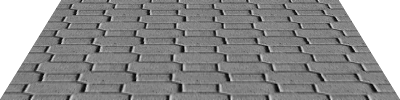
Example: Base image
Specs :: Stage :: Wall layers
Each background layer is made of (1 row of) tiles.Front tiles generally have a width of 1064 px and a height of 480 px (≈ 8.03 × 3.62 m).
As for room sides, we insert narrow tiles of 68 px width to accomplish the viewport span:
Same applies to hallways:
| A | B | C | D |
Due to occasional camera tilt effects, which uncover a bit more of the background horizontally, those side stripes must actually have a width of 86 px.
Horizon
Sky height (above horizon): 253 pxGround height (below horizon): 227 px
These add up to the 480 px background height.
Layer stack
Background tiles are JPG or PNG images, depending on whether they are final (no layers behind) or transparent (having one or more layers behind). Final (JPG) |
 Transparent (PNG) |
 Unused |
One of the simplest setups consists of just a backdrop. This is the case in the dungeon start room only, where no scrolling occurs:

Another minimal setup consists of a front wall only; allowing a basic scrolling effect:

For parallax scrolling we use at least one more layer.
 or
or  or
or 
In-between layers are optional; however, the depth effect will be lessened.
 or
or  or
or  or
or 
Image quality
Because of being usually out of focus, deeper background levels (1/2/3) don't need to be as sharp as the front layer. We can easily simulate this blur effect by serving smaller images, and let the browser enlarge them to their size as needed. This way we also have a lower data transfer volume, thus optimized download times.Image size / Scale
| Index | Layer | Behaviour | Scroll speed | Real Z distance | Scale | Tile image W × H (px) | ||
| Screen | File | Factor | ||||||
| 3 | backdrop | (fixed) | (0) | (horizon) | 1405 × 480 | 562 × 192 | 2.5 | |
| 2 | far mid | scrolling | ×.3 | ~ 24.03 m | 1 px ≈ 2.52 cm | 724 × 480 | 362 × 240 | 2 |
| 1 | near mid | scrolling | ×.65 | ~ 5.55 m | 1 px ≈ 1.16 cm | 612 × 480 | 408 × 320 | 1.5 |
| 0 | front | scrolling | (×1) | (0) | 1 px ≈ 0.75 cm | 1064 × 480 | 1 | |
| front side | 86 × 480 | |||||||
| curios | (scrolling) | ~ ×1.14 | ~ -1.31 m | 1 px ≈ 0.66 cm | ||||
| avatars | (scrolling) | ~ ×1.22 | ~ -1.86 m | 1 px ≈ 0.62 cm | ||||
| stage edge | (scrolling) | ~ ×1.44 | ~ -3.15 m | 1 px ≈ 0.52 cm | ||||
| camera | ~ -10.3 m | |||||||
Seamless tiling
To maintain a fluent visual transition, we need to provide seamless images.In the simplest case, borders would show half a global pattern/object (e.g. pillar), so all front tiles were automatically matching each other.
Room:
A slightly better solution, which diminishes repetition, would be to define at least two different, alternating borders (e.g. pillar and bricks).
Room:
For the near/far mid layers we don't need that much of variation; most of their areas are probably hidden by the front layer anyway. Therefore, mid layers are based on a single (repeating) tile each.
Near mid:
 | | | | |
 | | |
The static backdrop is just a single tile without repetition, thus its borders don't need to be seamless.

Scenery categories
As we see diverse environments in Darkest Dungeon, ...- Cove (caves near the sea)
- Ruins (remains of the Ancestor's manor)
- Warrens (subterranean tunnels)
- Weald (sprawling forest with rotted boughs, hosting a hideous kind of fungi)
Interesting environmental themes might be...
- Castle (medieval architecture, corridors, halls)
- Caves (jagged walls, flowstone)
- Hamlet (huts, shags, narrow lanes)
- Ruins (broken walling/windows)
- Swamp (moorlands, sparse, nebulous)
- Warrens (subterranean tunnels, pipes)
- Wasteland (scrub, dunes, collapsed walls/buildings)
- Weald (trees, shrubbery, deep forest)